Center for Research and Exploration in
Space Science &Technology II (CRESST II)
Overview of CRESST II
The Center for Research and Exploration in Space Science and Technology II (CRESST II) is a collaboration between NASA Goddard Space Flight Center (GSFC) and the University of Maryland, College Park; University of Maryland, Baltimore County; Catholic University of America; Howard University; and Southeastern Universities Research Association. The overall goal of CRESST II is to support and enhance research and technology in the space sciences in support of NASA's strategic science mission objectives. CRESST II also seeks to encourage the engagement of a diverse population of students and Ph.D. scientists in NASA's space science programs.
CRESST II employs, through its partner institutions, approximately one hundred scientists who work on a wide range of space science projects in the GSFC Divisions of Astrophysics Science and Solar System Exploration. CRESST II scientists work directly with NASA scientists to support of operating missions, conduct scientific research, develop instruments, and design future missions. CRESST II provides the unique opportunity to be university research faculty working at a major NASA Center.
CRESST II also provides opportunities for undergraduate and graduate students to become involved in scientific research and instrument development at GSFC. Undergraduate and Graduate students at the partner institutions can have research opportunities during the academic year. CRESST II operates a summer program that brings in students for 10-week research internships. Research opportunities Graduate students at the partner institutions can work on their Ph.D. research at GSFC.
CRESST II is committed to supporting its scientists during their time working at their partner universities. Information for employees can be found on the employees’ section of this website on a number of topics including: Frequently Asked Questions, CRESST II Reporting, Harassment Support and Reporting, Travel Guidelines and Support, Career Advancement and many other topics. If you have any issues accessing this portion of the webpage or questions about the content therein, please contact the CRESST II Program Manager Lee Cheyne.
CRESST II Scientist of the month
A CRESST II scientist will be featured here every month
CRESST II Scientist of the month, April 2024 - Dr. Mainak Singha is a Postdoctoral Research Associate in Astroparticle Physics Laboratory at The Catholic University of America. You can learn more about Dr. Singha and his work here.

Please check CRESST II Scientist of the Month Archive for CRESST II scientists featured in previous months.
CRESST II Research Highlights
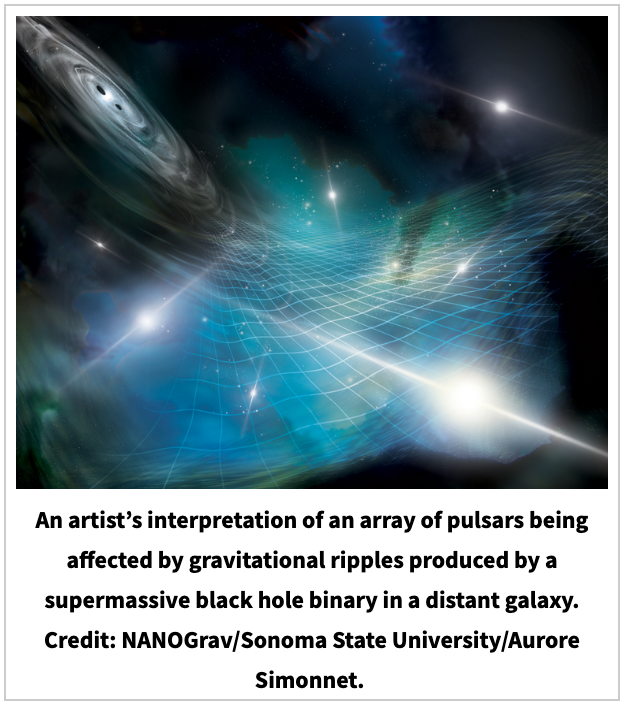
Evidence for the Gravitational Wave Background - The NANOGrav 15-Year Announcement
On June 29, 2023, the North American Nanohertz Observatory for Gravitational Waves (NANOGrav) made a major announcement during a live-streamed event from the National Science Foundation. The announcement reported results of the analysis of NANOGrav’s 15-year data set, and interpretations of those results. NANOGrav’s results were published in coordination with results that were released on June 28, 2023, concurrently by other PTAs around the globe. CRESST II scientist, Dr. Elizabeth Ferrara, played a role in this work. More about her contributions can be found here.
Watch The NanoGrav 15-year announcement for Evidence for the Gravitational Wave Background
Watch The Briefing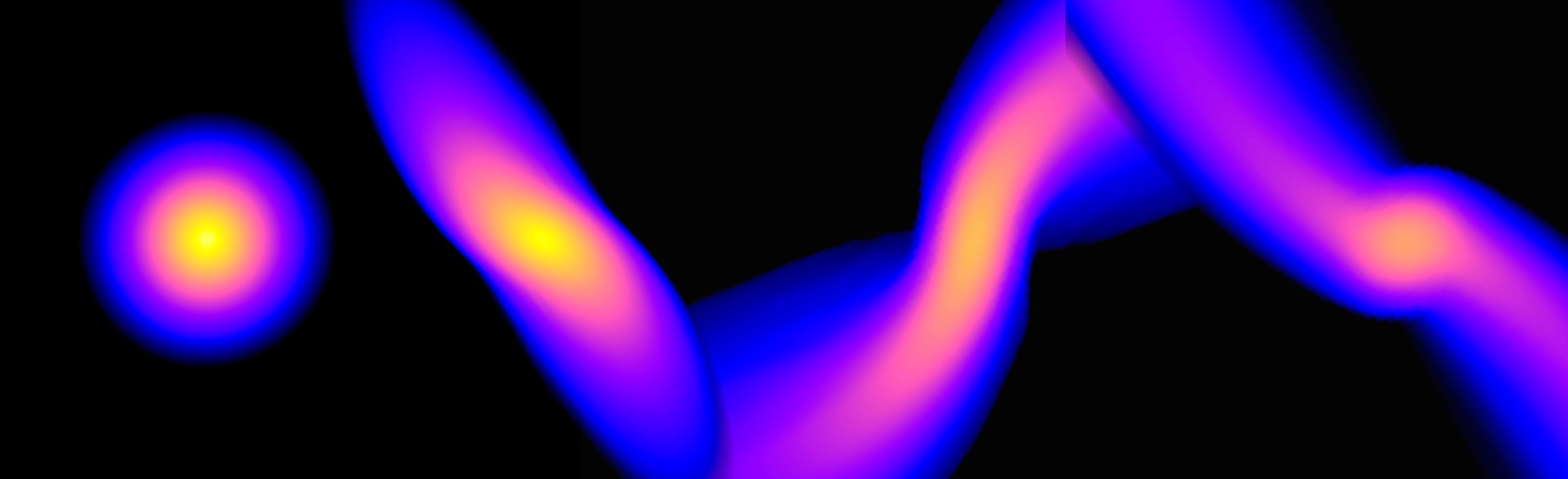
A video feature about virtual stars being shredded by a monster black hole
To celebrate Black Hole Friday (11/26), CRESST II science writer Jeanette Kazmierczak (UMCP) and video producer Scott Wiessinger (KBRwyle) put together a video feature about virtual stars being shredded by a monster black hole. It has over 411,000 views on YouTube, Twitter, and Facebook. The story was picked up by Popular Science, Universe Today, and others. The video was based on simulations published by Taeho Ryu, now at the Max Plank Institute for Astrophysics, and NASA Goddard’s Scott Noble. The details can be found at - Watch the video here.
A video feature about virtual stars being shredded by a monster black holeLearn More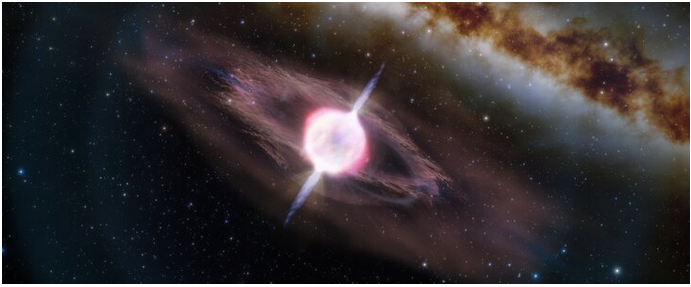
A Supernova’s ‘Fizzled’ Gamma-ray Burst
The traditional classification between long and short gamma-ray bursts indicate that the short GRB population is linked to compact binary mergers, however this particular burst GRB200826A was found in association with a late optical excess, only explained by a supernova. This makes this burst the shortest GRB powered by a collapsar ever found, and its short duration suggest it almost failed to produce ultra-relativistic jets. GRB200826A serves as a proof that most collapsars fail to produce a GRB.
University of Maryland Graduate Student and CRESST II scientist, Mr. Tomas Ahumada discovered the first optical
afterglow of a Fermi short gamma-ray burst using the Zwicky Transient Facility. The Zwicky Transient Facility
is an optical telescope system which monitors the night sky for transient astronomical event; University of
Maryland became a partner with Caltech in this facility in the hopes of making this exact type of discovery.
The discovery paper was published in Nature Astronomy on July 26th 2021. See
A Fermi Feature Issued by CRESST II Science Writer Mr. Reddy Receives Large Number of Views
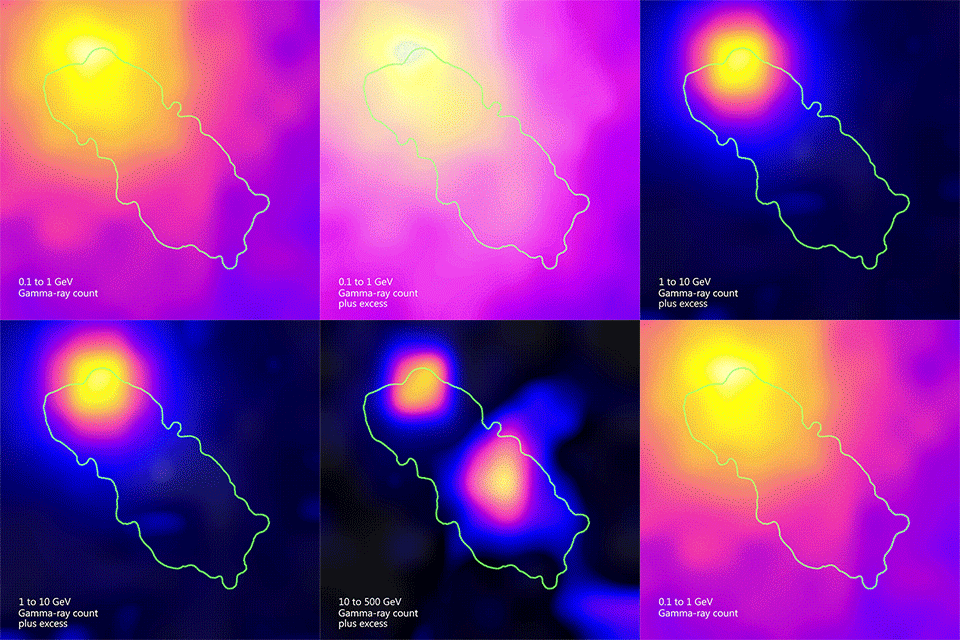
News and social media outlets have become efficient conduits for the dissemination of scientific discoveries to the general public. Mr. Francis Reddy is a CRESST II member of the Goddard AstroComms Team who enables the connection between science and the public. On Aug. 11, Mr. Reddy issued a new Fermi feature, with accompanying video and figures, confirming that supernova remnant G106.3+2.7 accelerates protons to petaelectron volt energies. The story received 180,000 combined video views, 14,000 interactions on Twitter and Facebook, and was accessed by more than 850 reporters on the Eurekalert service.
Click here for more information
Analysis of Young M Dwarf Flaring with the beta Pictoris Moving Group
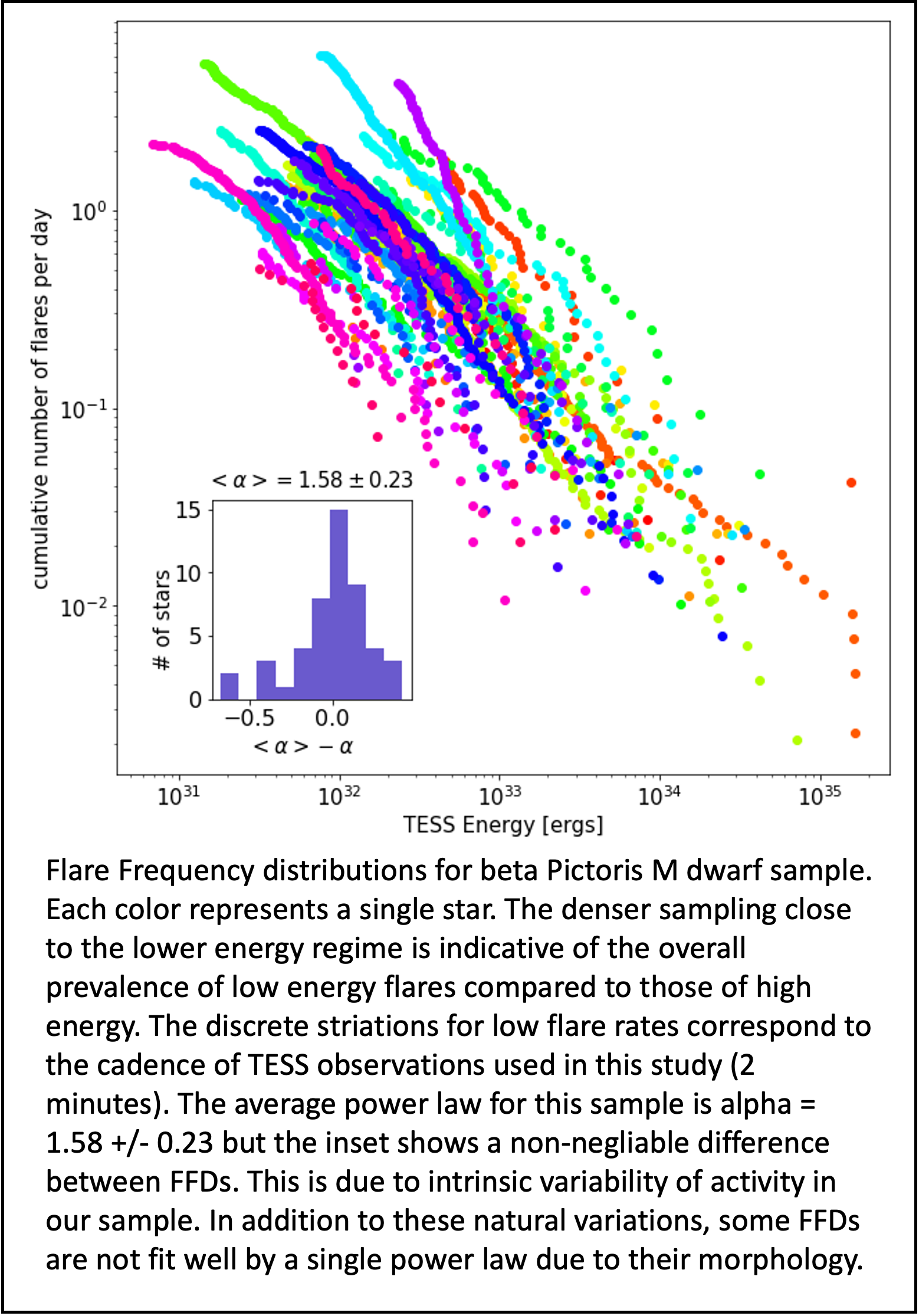
CRESST II student Jordan Ealy presented this work at 2022 AAS Exoplanets 4 meeting in Las Vegas, NV, and the Astrobiology Science Conference (AbSciCon) in Atlanta, GA, in June and July of 2022 respectively. Stellar flares release panchromatic radiation which, for M and K dwarfs, has a significantly higher brightness temperature (~9-20 kK) than the star. The excess ultraviolet contribution has strong implications for exoplanetary phenomena such as atmospheric loss, induced photochemical forcing, and the potential habitable zone. Increased frequency of magnetic activity on young M dwarfs results in the energy released during flaring events becoming a notable contributor to the radiation environment near the star. Consequently, characterizing the evolution of flare properties is crucial to understand the evolutionary context that is needed to interpret observations of exoplanet atmospheres. Using light curves of young stars from the Transiting Exoplanet Survey Satellite (TESS), we can map the frequency and intensity of flaring events through the key early epochs of planetary formation and evolution.
Learn MorePlease explore our website to learn more about CRESST II, our partner institutions, and the opportunities available through CRESST II.